Birth Day

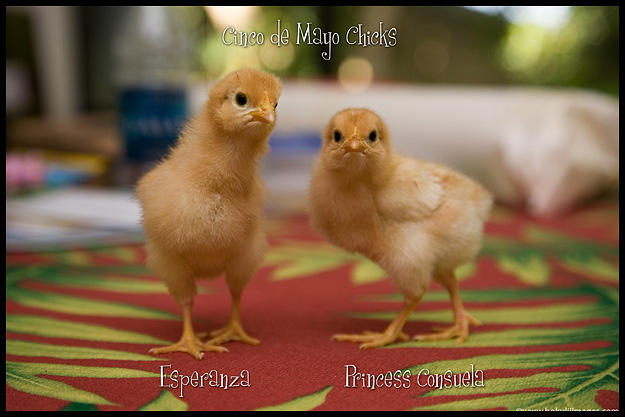
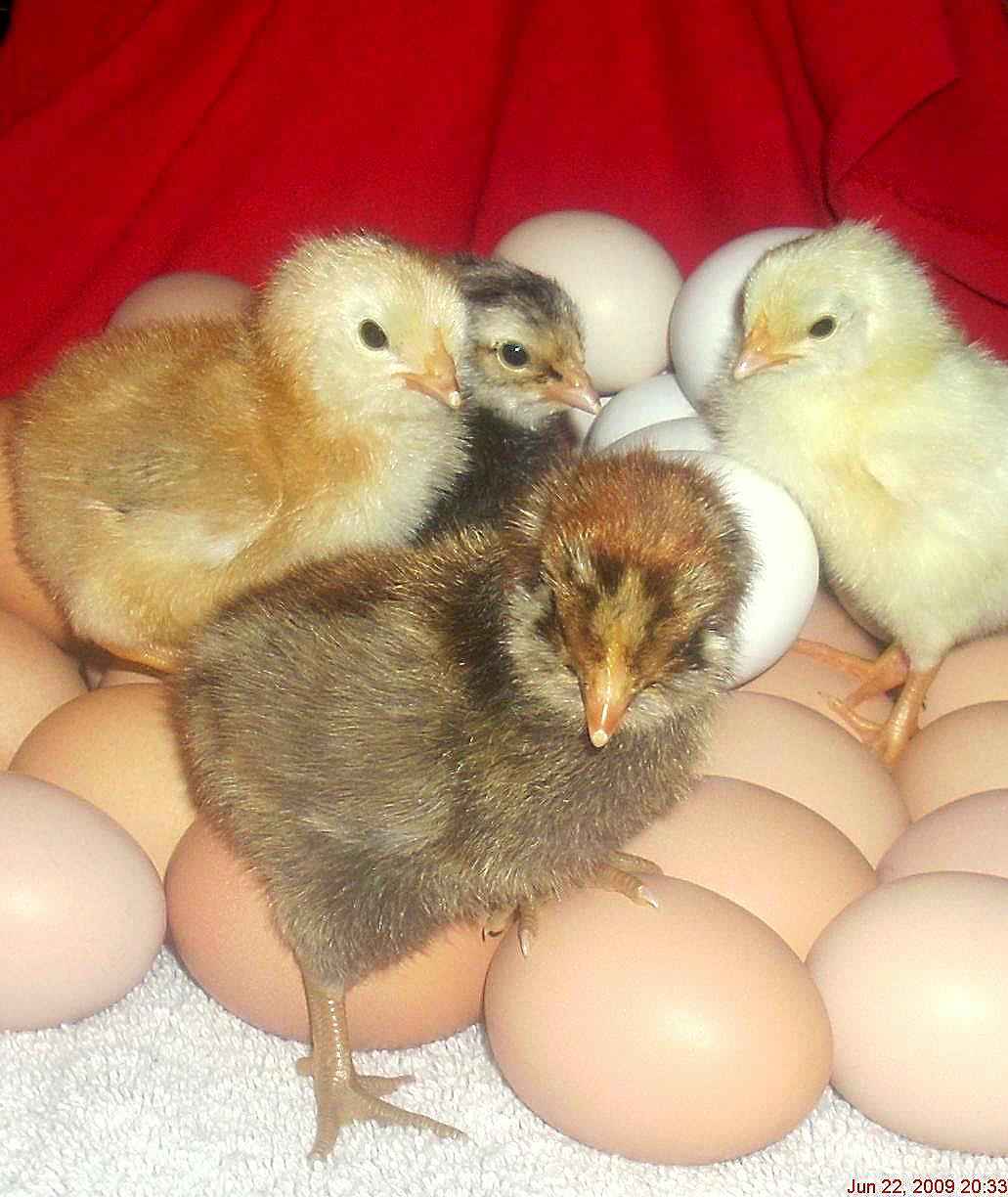
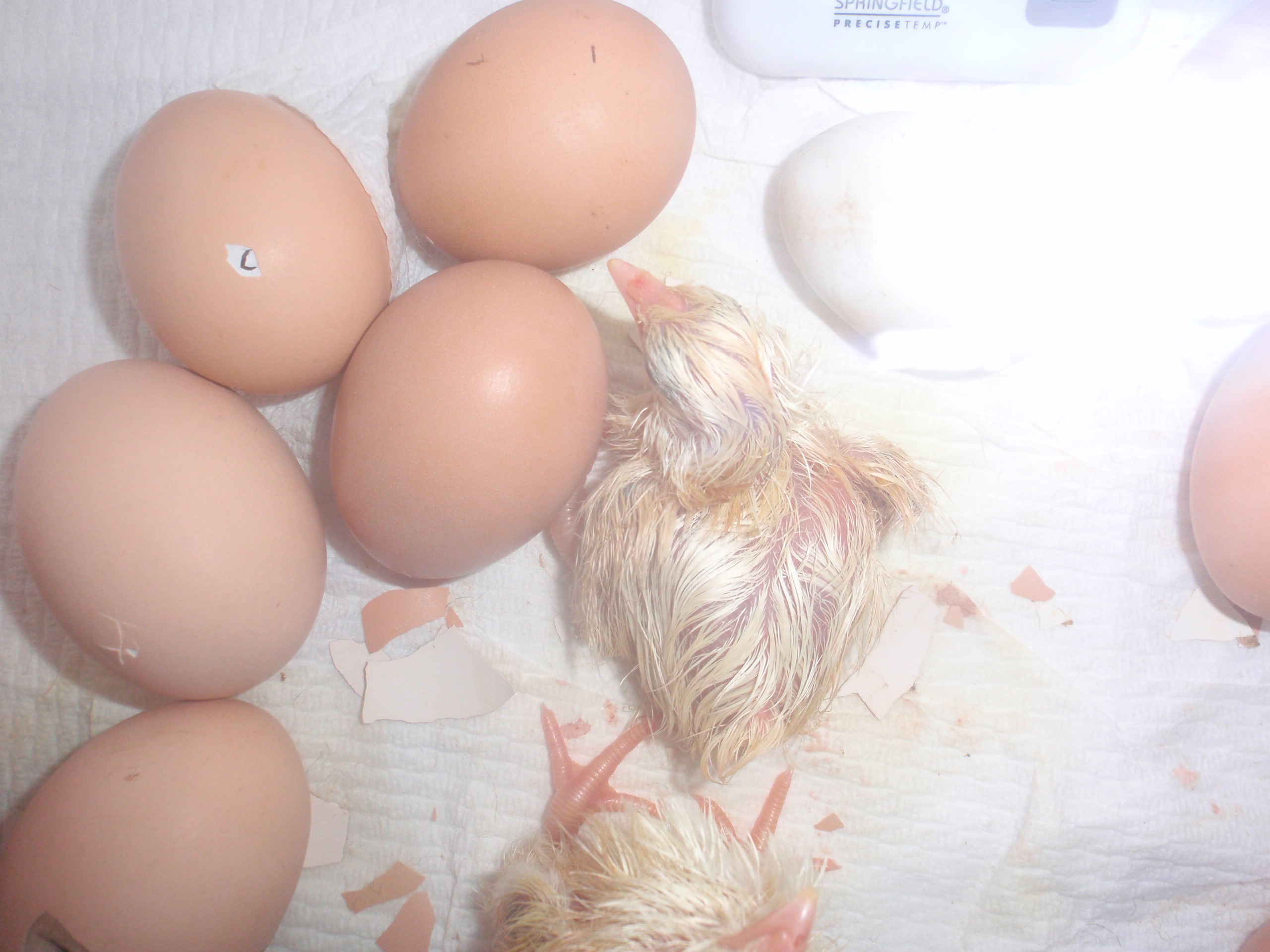
I was too tired to blog yesterday since I stayed at school until midnight the night before birthing babies. By the time I got home last night there were 16 chicks and that is the final total out of 23 eggs.  That is a 70% return and I am over the top excited, surprised, grateful for that number.  They are such a beautiful, diverse, little flock and we even got a special chick in the bunch.  But, let’s go back so I can get all this in.

Yesterday, when I arrived to school, three more chicks had been born in the night bringing the total of chicks to 5 at 7:30 am on May 4th.  At about 8 am we had another birth and by midday we had 9 chicks.  Our classroom was like a zoo with people coming and going all day to see the chicks being born.  Students could not stay in their seats and went back and forth all day to the incubator to watch for new hatchings.

The chick pips a single hole in the shell and then breathes air for the first time. After resting and acclimatizing, the chick will begin to use the egg tooth to zip open the egg in a circular fashion then they begin to stretch and kick.  Eventually, the egg begins to move and roll back and forth as the chick rocks its way out.  Finally, near the end of this process in a matter of moments the chick makes a few final big moves and slips from the shell.  After this, the wet and tired chick will sort of lie in a heap until it regains enough energy to try its legs at walking.
Each time a baby chick was born we would remove the eggshell from the incubator and sometimes it had a bit of afterbirth in it.  During one birth mid-afternoon, a chick was born who had its yolk sac still attached to its umbilicus and there was some blood.   The sac is supposed to be sucked up into the chick through the umbilicus right before hatching and this is what sustains the chick during the first two days of life.  This little bloody chick was freaking me and Sophia out enough, but on top of that the other chicks were pecking at the sac like they were eating it and so I ran for the school nurse [who is also our chicken expert and the egg donor]. She picked it up and sort of detached the sac gently and we put the little bloody chick into a paper towel lined plastic container so that it was separated from the others.  I was really worried about this chick, but he was right as rain by this morning and joined the others.  I actually knew he was okay when he stopped bleeding, fluffed up, and was trying to jump out of the cup and join his siblings.

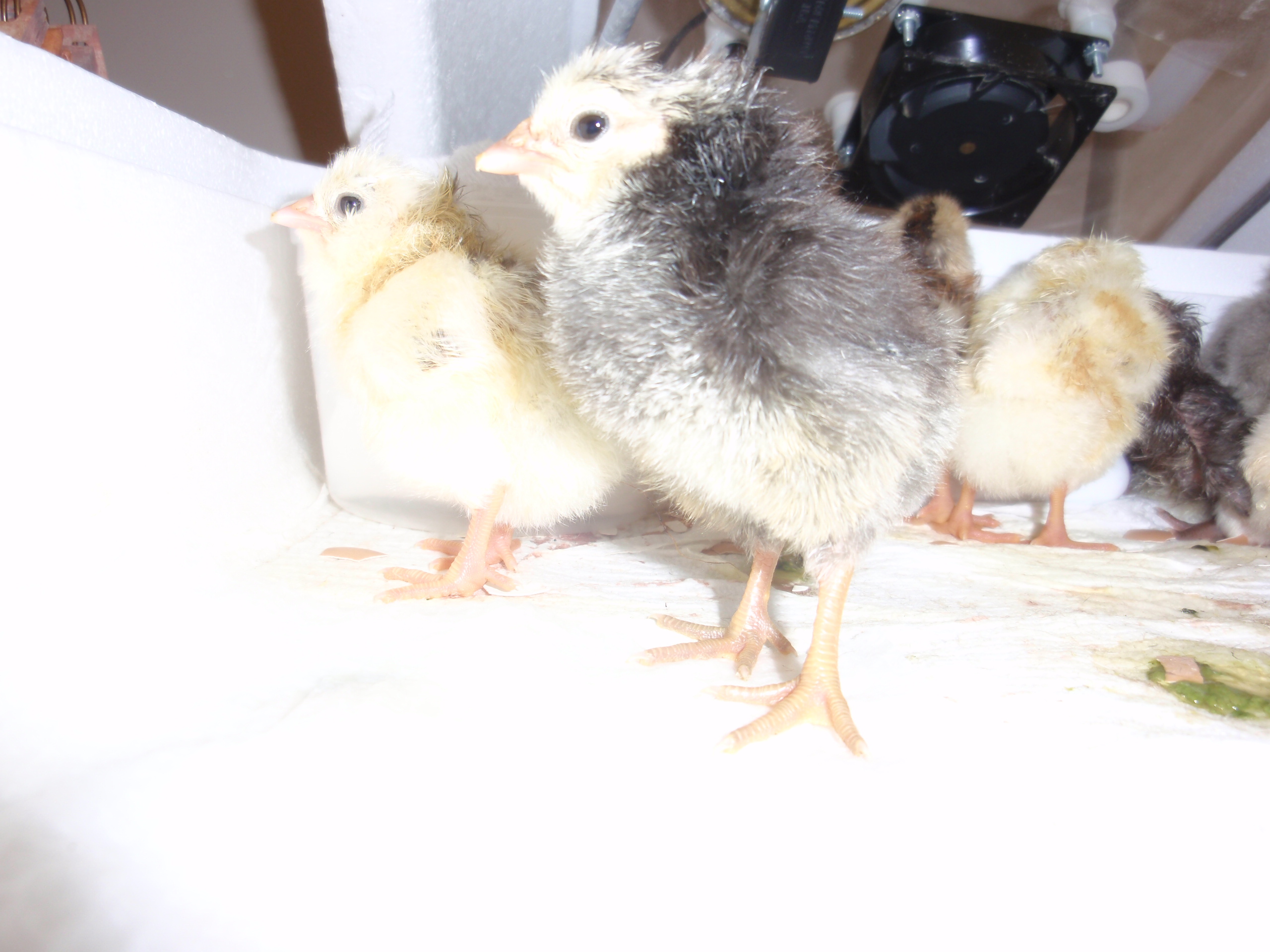
I came back to school after supper and a couple more chicks had been born, when I noticed that one of the chicks had a deformed beak– the bottom of the beak points one direction and the top beak points in another direction entirely.  I quickly googled this condition and found that it is a caused by a genetic fault and chicks born like this are commonly called crossbeaks.  The color of this chick is unique as well.  He has a dark underfluff with yellow on top of that so that it makes him look sort of evergreen or green-gray sometimes.  In the morning, Ms Burton recalled the chick that was different in Happy Feet named Mumble and so we named him Mumble.  I stayed at school that night [Tuesday] until 11:30 witnessing what turned out to be the last chick birth.
late night chicken update

This just in:  2 chicks born before midnight on May 3rd…

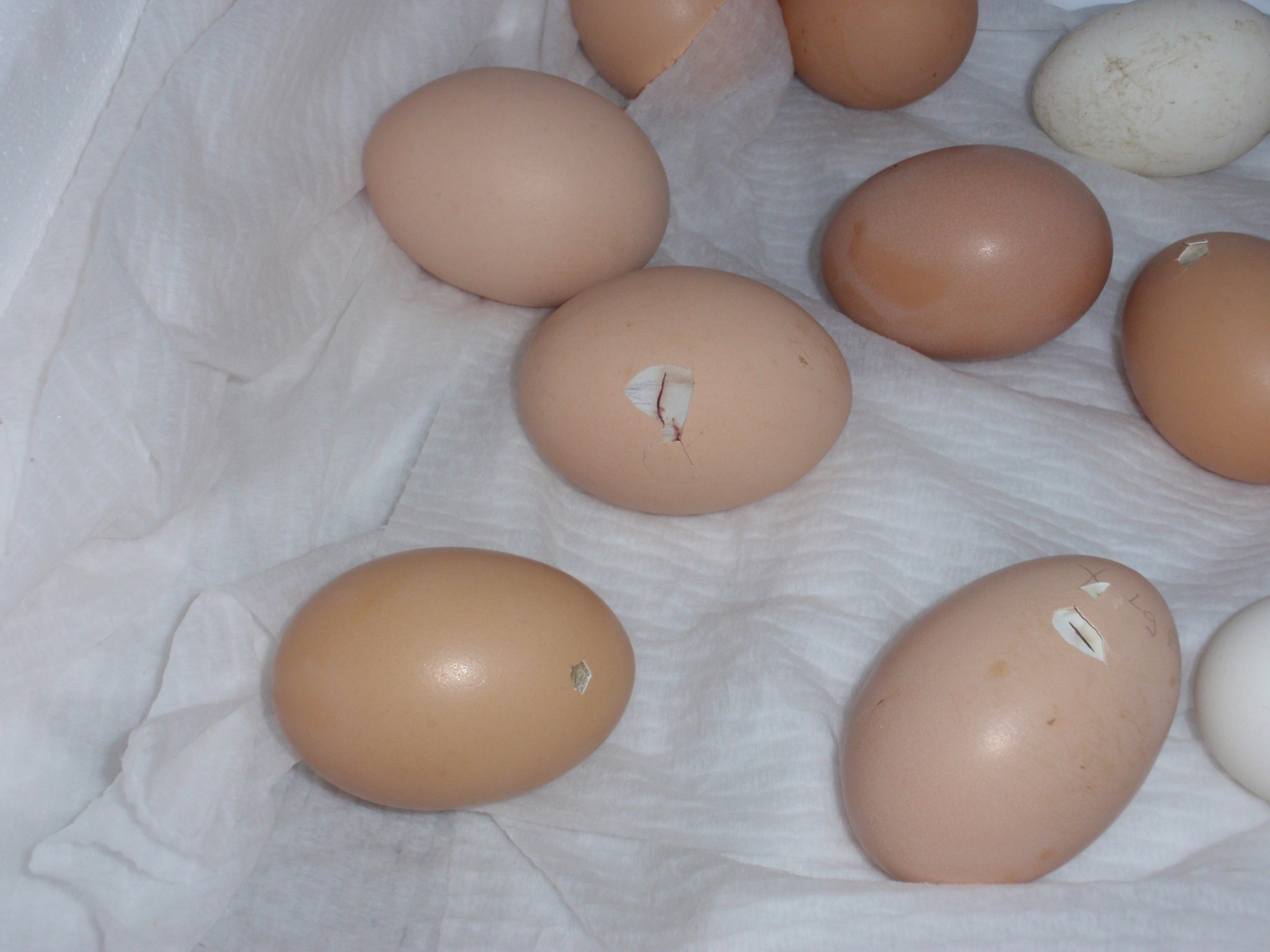
I am just getting home from school for the umpteenth time today and it is 2 minutes until midnight.  When I arrived at school this morning, I had every intention of removing the turning mechanism and putting in some wet paper towels to get ready for the hatching which was due on Wednesday!!  However, when I looked into the incubator I was surprised to find the chicks were already pipping.  I think that is correct phrasing… the chicks pip not the eggs.  I believe the chicks pip the eggs.  Anyhow, there were 8 or 9 eggs with pipped holes in them and I could hear peeping and chirping.  Well, I immediately sprang to life and action getting the warm water and paper towels and rallying the children like we were going to actually birth some babies.  All this excitement gradually gave way to anxious waiting as the day went on.  I was busy googling whenever I could trying to make sure our chicks had not pipped and died. I discovered that after pipping, they typically rest for 3 to 8 hours since the actual breaking of the initial hole in the egg is so incredibly exhausting.  So, I guess during the school day, we were observing the rest phase.  Sophia did not want to get on her bus and I did not want to leave after school.  The peeping was getting louder and some of the eggs were beginning to move, so I just stayed at school until 7:30 or so.  About 7 pm I was able to film the first chick hatching, which was absolutely awe-inspiring.  I was mesmerized and delighted.  I came back to school at 8:30 and then again at 11 and then again at 11:30 and when I came back at 11 another chick was born.  I have been trying to upload a video to this page for the last 15 minutes and no luck.  I will try tomorrow since I am too tired to reason.

Chick Update

So, if I am not mistaken, it is day 17 of chick gestation and things seem to be going well.  The temperature has gone a little sketchy only a couple of times [last weekend being one of those] and the humidity has been sometimes difficult to keep above 55%, but the proof will be in the pudding and we should be serving that up on Wednesday of this week!!!!!  Cinco de Mayo is their scheduled B-day, so I have lots to do this week to get ready.  I need to:

  • buy some baby chick feed
  • create some sort of brooder
  • create a water station they won’t drown themselves in
  • get a light set up that won’t cook them
  • order their coop

When we go back to school on Monday , we will need to begin steadily raising the humidity, because everything I have read says it needs to be high for them to hatch.  On Monday or Tuesday we will need to take out the egg turning mechanism and replace it with lots of wet paper towels in case they hatch during the night.  Once they begin hatching, we have to leave them alone until they all hatch.  We can’t help them, because it is part of their developmental process to get out of that egg.  They can stay in the incubator after hatching for up to 48 hours with no introduction of food or water, but they won’t need to stay that long.  I will be taking pictures, so that is something else I need to do this weekend:  charge my camera battery.

I am clearly more excited than most of my students, but that is okay… this is more than a lesson, it is one of those things I have always wanted to do :).

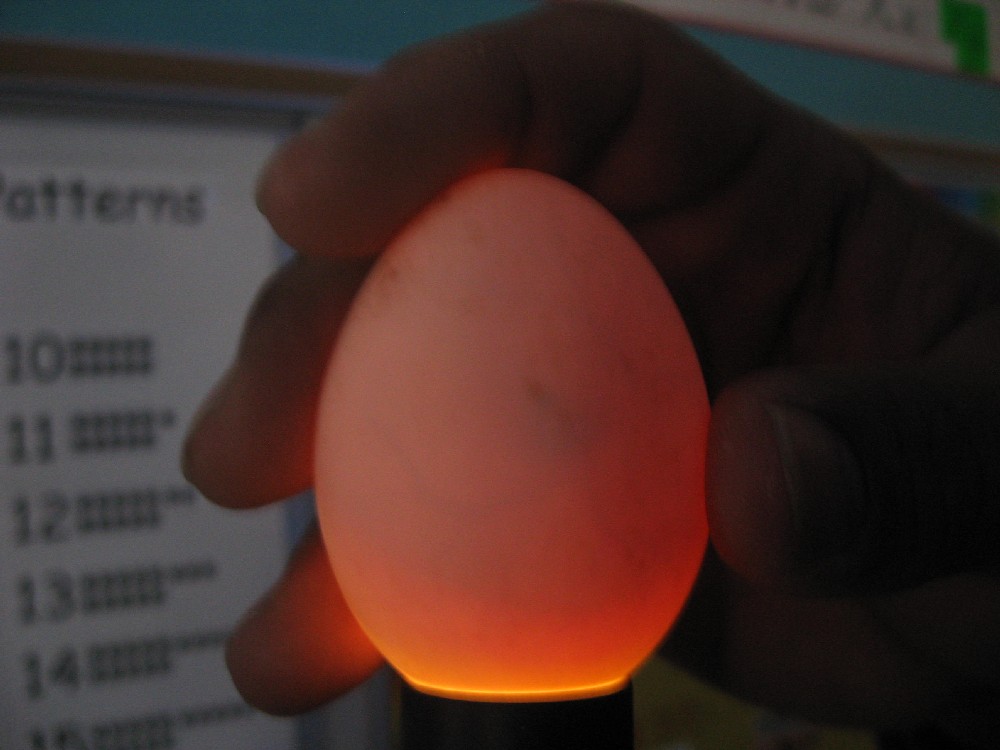
We candled the eggs with a flashlight and a cone of cardboard in the supply closet about a week ago, but it is an inexact science at best.   We could see a big blob in about 50-60% of them, and some we weren’t so sure what we were seeing, but in one we actually could see a heartbeat and the outline of the chick [which is actually scary to me since maybe we should have been seeing that in all of them and maybe only a handful or, God forbid, one is developing].  Since we are dealing with four different kinds of chicken eggs with differing shell opacity, weight, and color, it definitely affects how much you can see.  Our flashlight also left a lot to be desired in brightness and focus, so it was not as definitive an exercise as I had anticipated.

This photo is lifted from the Internet as we did not take pictures of our candling.  I am not sure what kind of light this is, but if we had put our eggs onto the flashlight we had, we would not have seen this.  We had to go into a completely dark supply closet one or two students at a time and check one or two eggs at a time until we did all 23.

I am hoping we get at least 12 chicks out of this, that is my goal, but I would be happy to witness just one hatching.  It is all a learning experience, and anticipation, like always, is half the fun.

Cupcake craze

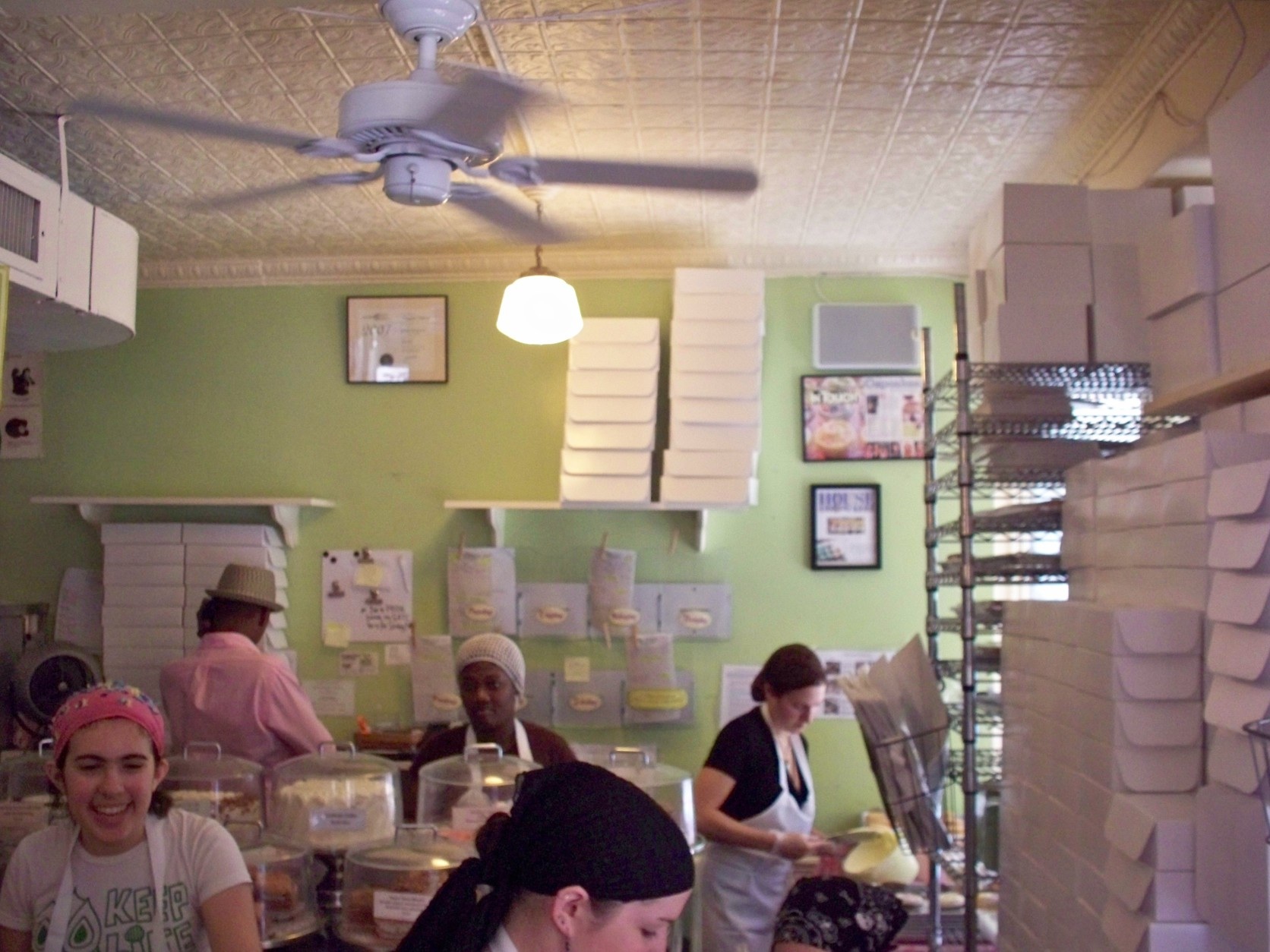
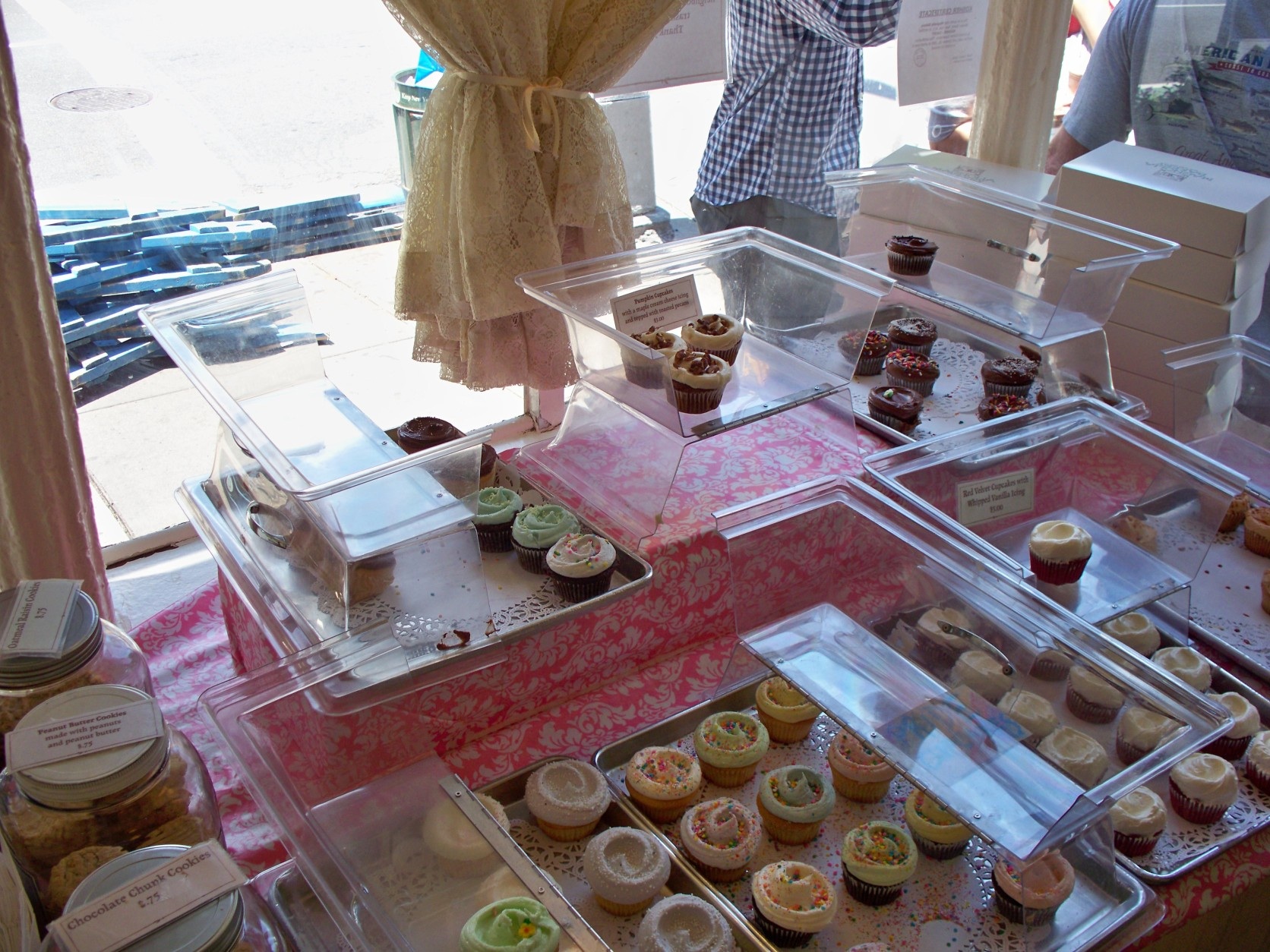
An article on CNN last month pulled me in with the title:  Cupcake Passion More Than a Trend.  Early on in this article, the author disputes the existence of a trend by reminding us that if this is a trend- it is a pretty long-lasting one -that started with Sex & the City and the Magnolia Bakery in the Village.  I have actually been to this bakery.  It is the quintessential cupcakery.  I even took pictures:

The bakery is small and filled with the soft, sugary smells that go perfectly with the pastel colors throughout.  The summer day my sister and I stopped in, it was filled with young women laughing and glistening with a sheen of sweat– busily baking, frosting, wrapping, and ringing up cupcakes as quickly as customers could fill a box. This was stop #3 on our cupcake tour of NYC and we made it only to a stoop around the corner before we sat down and devoured a cupcake and a half a piece in a matter of minutes.

This “trend” has spawned I would imagine hundreds of new businesses all over the country whose specialty is this tiny little cake that evokes so many memories for so many.  Close your eyes and try to remember your first cupcake experience.  Maybe it was your first birthday… I know I cannot remember that far back, but someone close to me claims he can.  For anyone over 40, the cupcakes you remember as a child did not come from the Kroger bakery or from any bakery… they came from your childhood kitchen, baked by your Mom for your class birthday party.  As a young parent, I found such joy in recreating those moments for my own children, taking baked cupcakes for my boys on their birthdays to preschool and later elementary school for class parties.  I even had a special carrying case to carry them in.. it held thirty cupcakes and got them to school with every dollop of frosting completely intact.  Unfortunately, today in quite a few of our schools, home-baked goodies aren’t even allowed and only store-bought confections can be doled out at class parties.  I assume this is due to the proliferation of children with food allergies and the need to know exact ingredients and have some measure of accountability, but how sad that the few moms and dads who actually have time to bake are no longer allowed to contribute in this way.

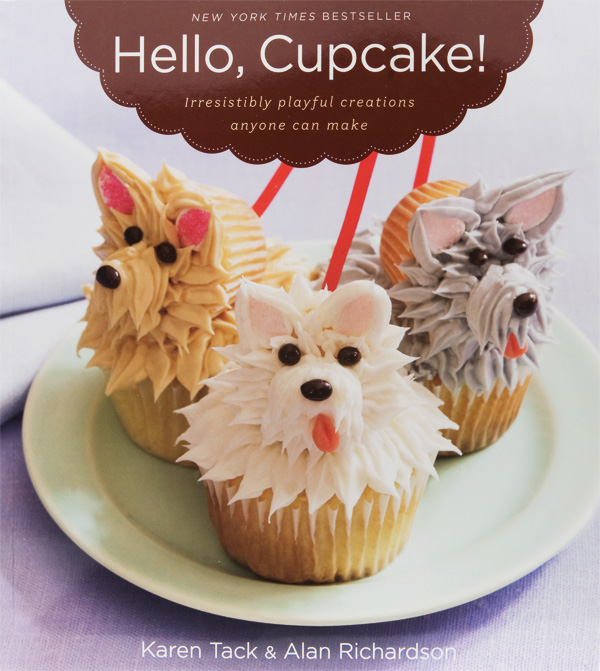
Homemade cupcakes can still be found at home parties and even weddings.  Young mom’s  and kids everywhere are now out doing us by making cupcakes that are literally works of art.  My sister and her teen daughters have even made some of the cupcakes featured in the wildly popular cupcake book Hello Cupcake!

Go to Amazon and type in ‘cupcakes’ under books and you will find 1,111 hits.  I even found a cupcake book about the Magnolia Bakery.

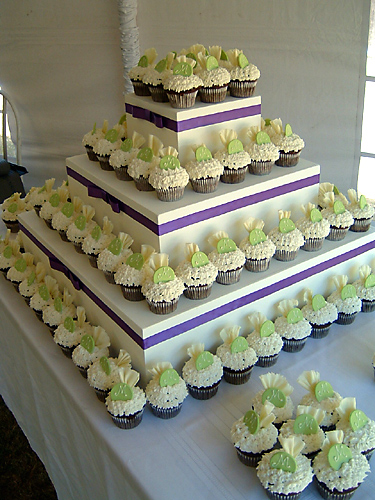
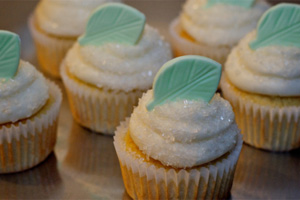
The cupcake wedding cake has become somewhat of a trend in the past five years or so.  This choice is often cheaper than a large, elaborate cake and a larger variety of flavors can be offered for guests.  

The Cupcake Bar in Cary, NC [who knew] sells cupcakes flavored like your favorite drinks with flavors like Mojito, Mint Julep, Strawberry Daiquiri, Mocha Latta, and Chai Tea.  They also have house favorites like red velvet and traditional flavors as well as filled cupcakes.  Top shelf cupcakes are $30 a dozen plus a delivery fee [if delivered to your home or office].  They appear to be doing a booming business despite the economy.

The gourmet cupcakes found at these homespun businesses are a giant improvement over the grocery bakery cupcake and even a notch up from ordinary homemade cupcakes.  But, at often more than $2 a cupcake, they are pretty costly.  I can see buying these for an office function or a party or occasion, but not simply picking them up for the family very often.

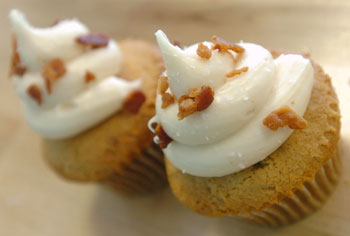
Two female marketing majors fresh from the UNCW school of business are whipping up interesting and delicious flavor combinations at Coastal Cupcakes in downtown Wilmington.  Last year they developed the bacon cupcake that tastes like, yup, bacon. It’s on the savory side– a crisp cupcake infused with crunchy bacon pieces and covered with a creamy sweet maple cream cheese frosting along with some sprinkles of sea salt.  People line up out the door to get these cupcakes and they have sold out nearly every time they have had them.

Cupcakes first appeared in the early 19th century.  Some people say they were named for the cups they were baked in and some people think they were named for the measurements needed that were mostly measured in cups.  I picture them as a very 60’s confection, but apparently they were no more popular in the 50’s, 60’s, and 70’s than they are today.  They are simply a nostalgic item since so many people associate them with their childhoods.  In England they are known as ‘fairy cakes’ since they are just the right size cake for a fairy.

The original cupcake bakery is Sprinkles in Beverly Hills, CA which now has almost 10 locations with a dozen more to come shortly.  A Sprinkles is even in the works for Charlotte, NC.  Most of the cupcake bakeries that have sprung up all about the country have modeled themselves on this original chain.  They are pricey, though, with some upwards of $50 a dozen plus at least a $15 delivery fee.  If you’re figuring, that is more than $5 per cupcake, so I would say they’d better be more than just good.

According to an article I read on Slate, the bubble is already here and the crash is coming.  This author believes that the cupcake is an affordable luxury riding the coattails of the recession and that after the recession recedes, the cupcake bubble will burst.  I personally do not see how cupcakes alone can float a bakery, especially in a small city or how numbers of cupcake bakeries can compete in larger markets, but I do love a cupcake.

And, oh, Megan & Hannah, keep dreaming of your own cupcakery… maybe you can combine it with your Mom’s love of books [and maybe even Dad’s love of sports in general and golf specifically] and give BN a run for their money in WF 🙂

Cinco de Mayo

This morning when Antionette asked if the chickens had been born, we told her no, they would not be born until Cinco de Mayo.  She promptly asked, “what is Cinco de Thymo?”  So, I thought I did a fairly good job explaining this holiday as a day when people in parts of Mexico celebrate a war victory from a long time ago with parties and celebrations and that we would be celebrating the birth of our chickens.  Later, when Bailey came into the classroom, Antionette said; “guess what… our chicks are going to be born on Cinco de Mayo!  Do you know what that is… Cinco de Mayo?”  When Bailey said, “no,”  Antionette told her ‘Cinco de Mayo is a holiday where Mexicans hang chickens.’  How she got that out of our conversation… I will never know 🙂

Chicken Lottery

Four days ago, on April 14th [tax day eve], my students and I placed 23 eggs into an incubator in the classroom and began studying embryology.  This is my very first foray into hatching chicks and so I am as excited or more excited even than my students.  Between researching the unit and entertaining a guest speaker this week, I am learning right along with my class.

Here are some random and interesting facts that I have learned.  We need to keep the incubator temperature around 100 degrees.  A hen’s normal temperature is 107˚.  The humidity in the incubator must be kept around 50% until a few days before hatching, when it should be raised to between 75 and 85%.  Most of the eggs you buy in the store are not fertilized– if you find a red dot on the yolk, then that egg was fertilized.  Once fertilized the eggs can hang out for days with the embryo in sort of a state of suspended animation until someone decides to either incubate them or sit on them.  Once they reach an internal temperature of 85%, development of the baby chick will commence.  Chickens need Roosters in order to lay fertilized eggs.  Chicken sex, however, is not what you would think it would be… it is really just an exchange of fluids between the rooster and the hen.  After they are born, baby chickens can live for like 48 hours with no food or water, but once removed from the incubator and mom, should be given baby chicken mash and plenty of water.  The water, however, should be offered in such a way that the baby chicks will not drown themselves, for instance in a shallow pan filled with marbles where they can drink around the marbles.  For some reason, perhaps their recent exit from a watery environment, the chicks are drawn to the water and will fling themselves into it and drown during the first days of life.

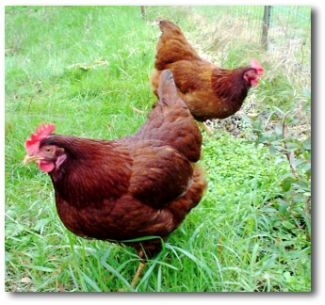
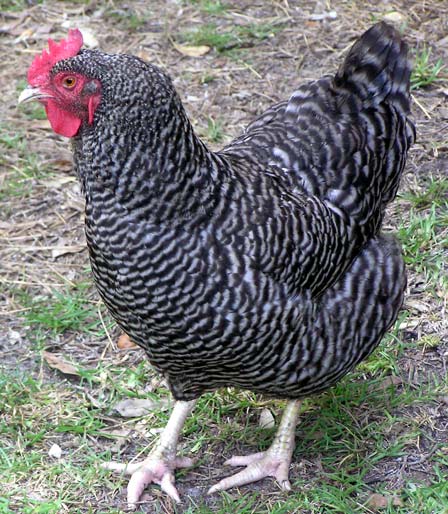
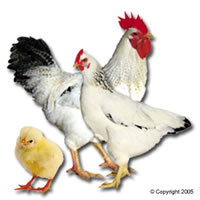
The chicks are due to be born on Cinco de Mayo, so we keep teasing they will be ‘Latin chicks.’  Of the 23 eggs, statistically, about 50-75% of them may end up with chicks developed and capable of pecking their way to freedom.  So, I wonder, almost daily, how many we will end up with and what they will look like.  The eggs were taken from four types of chickens:  Rhode Island Reds [whose chicks are sort of calico brown and yellow], Delewares [who produce the ubiquitous fluffy yellow chicks], Barred Rock Hens [dark brown chicks], and Bantams [I think also yellow chicks/white adults].  So, we could have any combination of breed and gender.

If you know me then you know that one of the items on my bucket list is to raise chickens, so I plan to take three hens home at the end of this project.  I live in a neighborhood and have no place to put three chickens, but I plan to order a portable chicken coop that looks like an A framed chalet.  I found it on the Internet and one of the places you can purchase it is, wow, Amazon.com.  You can really find nearly anything on Amazon.

It’s Sunday and I actually went in to the school three times yesterday to check on my eggs and make sure they are still at the right temperature and humidity.  Last week was spring break and it flew by, but now that we are hatching eggs, the time is creeping slowly by.  We are only on day four and today the embryos are about the size of butter beans.  We may get to candle them this week in order to see which are developing the way they are supposed to.

RHODE ISLAND REDS

BARRED ROCK HEN

STANDARD DELAWARE CHICKEN

Egg Hunt at the Senior Center

If you read the title first, no doubt you might be imagining a sweet spring scene– a green, grassy yard with a spattering of kindly elderly folks slowly and happily making their way about the lawn and joyfully collecting a few eggs.  That is what I would picture– but no, that is not what happened at the hunt our students helped with last week.

disclaimer:  I am writing about this secondhand.. as told to me by fellow teachers and students who were actually there at this senior free for all.

Last week, my co-workers, Holly and Tammy, took their EC high school students to the local Senior Center to hold an Easter Celebration that included lunch, a visit from the ‘Easter Bunny,’ and an egg hunt outdoors.  They came back exhausted, but laughing with a new perspective on the elderly:  and I quote:  “they are mean.”

Now before I even heard the story, I did agree, that indeed, a lot of old people can be mean.  As a younger person, I had the notion that all elderly people were sweet and kind, but as I have gained more experience in the world [and met more old people], I have come to the conclusion that the state of getting and being old does not make one nicer.  In fact, it might make you less nice.  I think if you were charming and had good social skills as a younger or middle-aged person, then you might keep that into old age.  You might lose some of your positive edge, if getting old involves some physical or emotional pain or if life has dealt you a lot of hard knocks, but if you were mean in youth, you will be mean [or meaner] in old age.

I have a neighbor who used to drive me crazy being rude and hurting my feelings all the time.  I used to wonder how an old woman could be so awful, and then one day I had a lightbulb moment and realized that she had been like this all her life.  As a young person, she was most likely controlling and socially and verbally inappropriate, as she aged, instead of getting softer and more enlightened, she just became a harder version of herself.  That finally explained why even her children and grandchildren who lived in town, rarely came to see her.  But, I digress.

The senior center egg hunt went something like this:  Our students carefully hid three large grocery bags brim-full of plastic eggs filled with jelly beans along with some wrapped candy eggs.  The senior hunters were then escorted down the ramp and out to the yard.  Some of them were in wheelchairs, mind you, or had canes to assist them, but they all had their bags or baskets ready and were then let loose to find eggs.  According to Tammy, it was a indeed a free-for-all, with the younger seniors who were more ambulatory, raping the green canvas of eggs in less time than it takes the average person to brush his/her teeth.  The less ambulatory seniors had hardly maneuvered their wheelchairs down the ramp and onto the grass or used their canes to amble out onto the grass before it was over, and “poof” and they were left holding empty bags and baskets.

I asked if there were any acts of altruism– if perhaps, any of these more physically fortunate seniors shared their vast egg bounties with the others who were less competitive?  The answer was “no; no one shared.”  In fact, on their way to the grassy egg containment area, a few of these very excited seniors almost knocked over some of their less steady friends to get a jump on those eggs.

The stunned students and teachers who would have gladly helped the less physically able stood helplessly by as the eggs were swooped up by crazed ‘seniors’ running wildly about.  These ‘fast ones’ were the ones who drove to the senior center that morning from their homes and parked their cars in the parking lot between Main and Foushee; some of them seemed like they were barely seniors at all.  Much of the older and slower crowd had arrived by van from nursing homes and senior housing projects.

Prior to this, all had gathered for lunch inside the center.  Even this was not pleasant.  Many of those lunching complained about the food.  “Is this all we get for our money?,”  a few of them were heard to exclaim.  Now, I have to tell you that the cost of the meal was $2.00 [yes, two dollars], and for this price they were given a hot dog, chips, two cookies, and a milk.  One student serving was asked by a scruffy-looking man with very few teeth, if he could have two hot dogs.  When the reply was negative, he asked for another buttermilk, and when told that each person was to have only one, he yelled, “I don’t see why; I’ve already had four!”  This was the same man who later, after stepping outside, asked the student who was dressed up as the Easter Bunny [in a full bunny suit] if she had a cigarette.

All in all, this was an eye-opener for many of our students and for our teachers as well. Holly said she couldn’t wait to get out of there, but looking back on it, she did have to admit it was all pretty funny.  By the way, Tuesday evening was the county egg hunt for children, which is always another really keen study on human nature.  Virtually all of the children act nice, and most of the adults act like idiots trying to help their offspring ‘win’ and in turn teach them what is really important in life:  getting the most eggs is much more important than the fun of helping someone else or sharing.  And, we wonder how elderly people ever become greedy or mean..

2010 Census, the Negro, and the Chicano

So, this week the Census forms came in the mail.  I did not open mine, of course, since I have don’t even have time to open my mail until I am forced to find my kitchen table again, but evidently Sophia opened hers and was angered by the race choices she found on this form that was, indeed, created for the year 2010.

As soon as I arrived at work the day after the Census delivery, Sophia explained that on the section where she was to check race, she found that one of the choices [the one she would usually check] was listed as, and this is one choice as if these terms were analogous, mind you:  Black, African-American, or Negro. And, why yes, you did read that correctly:  Negro.  Sophia wondered if it was just her, or did this term sort of go out in the 40’s or 50’s?  I replied, that, well, yes, I thought it did.  I even wondered aloud why the first category did not read, White, Caucasian, or Cracker. Seriously, it does not even read ‘Caucasian,’ just ‘white.’  We had to laugh, but only at the absurdity of the situation.  So, I did a quick google search of this issue and found that, not surprisingly, Sophie was not the first to find this choice offensive.  Many people are questioning this choice of language, by the amount of hits I got from this query [more than 16,000].

What does the Census have to say about including this random and archaic race term on the current form?  Well, they say that in the year 2000, more than 50,000 respondents voluntarily wrote in Negro as a race identifier.  I personally, find this difficult to believe, but stranger things have happened.  Maybe these people were cued by the word listed as one of the race choices, maybe these people were really, really old.  The Census also contends that there is a test embedded in the form this year that will determine how they will classify race on future forms, but just how this test works is not shared on their website and even an inkling of how it might work escapes me.

Some people, including me, question why race is even a factor for the census– why in 2010 we need to sort people into categories by the color of their skin.  Many Americans today are of mixed race, including our President.  I wonder which box or boxes he will check, and if he, like Sophie, will be offended by having to identify himself with a term with such derogatory connotations that harken back to Jim Crow and slavery.

Note that race and ethnicity are separate entities, however, on this form they sort of blend into one confusing phenomenon where race is sort of interchangeable with ancestry and ethnicity.  Another interesting observation that can be made if you study the race/ethnicity choices on the form is that the Census seems to offer a lot of separate choices as it corresponds to you being non-white but not black and less interested in differentiation if you are white or black. For example, you will find the choices:  Hispanic, Latino, Spanish, Chicano [where do Chicanos come from, anyway?], American Indian, Alaska Native, Japanese, Filipino, Samoan, Chinese, Native Hawaiian, among others etc…, however you will not find categories like Finn, Celtic, Swede, German, Bantu, Tutsi, Ugandan. Another weird omission is any categories for Middle Eastern or Arab peoples.  Now we have been profiling the hell out of these folks since 911 from the airports to people just paddling around trying to help out after Katrina and you would think that the folks from the US Census would be wanting to know where these people live, but in fact, there is no box for them to check.. they could write it in or accept what the US Census has determined– that Arab is not a race.. they are Caucasian.  This seems to tick off some Arab and middle eastern folks too according to some blogs I have perused since beginning to dig into this subject.

Sophia said reading the word ‘negro’ made her so angry she did not want to finish filling out the form and put it down.  So, if you’re offended by this form or you just don’t want to share your race because you don’t think the US Government needs to know it, can you just omit this question or not fill out the form?  Well, no, because this is a crime.  In fact, you could be fined or imprisoned for up to one year for this.  So, I encouraged Sophia to write her race in.

There is so much about this form that is strange and ridiculous that it could keep bloggers in material until the next Census.  Like why did the US government pay ungodly amounts of money to print and mail me a form that told me that I was going to get a form in another week?  And, why don’t they want to know what my education level and income is?  Pretty much, regardless of my race, if I am born today in America to a poor family who does not value education, that is where I will stay. So, I would like to see us identify women and children living in poverty in this country and spend some money trying to find out why immigrants can come to this country with nothing and very often rise with relative ease in social status, but we continue to have populations so marginalized that they are seemingly ‘stuck’ in their socio-economic status generation after generation.

Recycle

I am finally back to blog after five blissful days of spending time with Bean.

Today, students released early so that teachers could have staff development time.  Usually, this is a colossal bore, but today myself and a few other select teachers got to go on an EC field trip, which was right up my alley.  We went first to visit the local MRF or Materials Reuse Facility, I think that is what the R stands for, but it might be Materials Recycling Facility.  Basically, it is a giant warehouse filled with discarded materials [looks mostly like mountains of trash].  Employees of this facility use conveyor belts and machines to sort, compact, and bundle recyclable materials like plastic, glass, cardboard, aluminum, and steel.  Many of the people employed have been in our program or personally taught by me at the local high school.  This center provides a very needed recycling program for our community and provides jobs for many people who have developmental disabilities.  It is a win-win situation that will grow and expand in the coming years.  It was very exciting to see these young adults collecting recycling from the cars and vans that pulled in to deliver it, sorting by hand and using conveyor belt sorting systems, and moving mountains of materials around using forklifts and front loaders.  Those mountains of trash– empty plastic laundry detergent jugs, milk jugs, 2 liter soda bottles, cans, boxes–  were an incredible sight piled up like colorful and chaotic mountains offering a real visual on how much space we can save in landfills if we just recycle anything and everything we can.  I currently recycle some things, but I do so inconsistently by bringing bags of paper, cardboard, and plastic to school for the recycling team to sort and cart away.  Seeing how easy it is now in our community to recycle– we don’t even have to sort anything; they do it for us– made me vow to call today to get a blue cart to collect in at home.  My trash service will pick up the recyclables for me and take them to the MRF center every other week.  How simple and wonderful is that?

Our next visit was to the Vocational Rehab Facility on the boulevard where people who need vocational rehab can work at jobs like sorting paper for the recycling center, packaging, and small assembly tasks.  As soon as we walked onto the workroom floor, I saw a former student, Jeffrey, who ran away from his station to hug me.  I continued to receive hug after hug from former students who were working at this facility.  One talked to me about how he sorts paper by whether it has color printed on it or how heavy it is.  One explained how he was using a small sharp tool to stick into an assembly piece from a local manufacturing plant to make sure the holes were viable so that these parts could be used.  We heard a lecture on how funding has been drastically cut at the state and federal levels, but especially the state level for funding that provides opportunities and jobs for persons with developmental disabilities, mental disabilities, or who require vocational rehabilitation.  It makes me angry that this population is seen as so marginal that their funding can be so easily snatched away and that more people, including myself, are not so outraged that they are doing something about it.

Our next stop was to an adult day program on Main Street for adults with moderate to severe developmental disabilities.  Here I ran into two former students.  Matthew jumped up from his chair and ran around the tables to give me a giant hug.  I did not think he was going to let me go.  Garrick is a student who I had not seen in years and years.  He was one of my first and most special students.  He is now 31 years old.  I looked at him and he did a double take.  He said simply in his gentle robotic fashion, “Kim Whitman,” and then he put out his palm and said, “scratch hand.”  I asked him who the 15th President of the United States was, and he answered correctly James Buchanan; he then told me as I asked for each one that the 23rd was Benjamin Harrison, the 33rd was Harry S. Truman, and the 39th was Jimmy Carter. I asked which number Barrack Obama was and he answered, “number 44.”   This student knew this in high school, but I always got a thrill from quizzing him on presidents, world capitals and random geographical facts and historical dates.  As a young adult with Autism, he could remember teachers license plate numbers, and state all of these random facts, but could not tell you the sum total of a dime, a quarter, a nickel, and two pennies.  No matter who they are or how long ago I have taught them, they always remember me.  No matter if my hair is a different color, or I am wearing sunglasses, or it has been 12 years since they have seen me.  They remember and they are happy to see me.

Finally, we visited a local group home which was clean and tidy.  It had six neat and personally decorated bedrooms, two bathrooms, a living area with a large flat screen television, a long communal dining table, and a kitchen sporting charts that listed who was on which kitchen or domestic duty for each day of the week.  Person County Group Homes are exceptional.  They a Godsend for the people who live in them and for the families who love and support these adults.  It is so important for adults with developmental disabilities to be able to grow up and leave home and lead as independent adult lives as possible.  They blossom and thrive in settings where they share daily domestic tasks with other adults and enjoy social and community involvement outside of their family of origin.

After this awesome field trip, I headed to Tricia’s Coffee Shop for a coffee ice cap where I ran into one of my foster children with his social worker.  Now, I am about to head out into this beautiful, warm evening for a walk/run.

Thursday.. and in 2.5 hours it will be Friday :)

Today was an exhausting day, but a good day.  I got to sleep slightly later and then had a good coffee and chocolate almond biscotti on the way to Burlington for my large team meeting with ESUCP.  This was our last time as a large group since the restructure begins on Monday, so I was grateful to get to see all my old friends, coworkers, teammates.  It was a productive day and I won several prizes and received a ‘goodie bag.’  I also got to get some things off my chest that I definitely needed to get off, and that went well.  Today was rainy, but still warm and the drive was pretty. The ponds are very full and the Haw River was racing over the rocks.  I would like to go for a hike down at the historic Glencoe Mill site sometime.  It is so beautiful in that area and it is right on the Haw River.

Alex left for Wilmington today, and the house is quiet tonight and still.  Had dinner with Jason, Jenn, and Cam tonight at their house– tortellini and salad.  Home now watching a new episode of Grey’s Anatomy and tomorrow is Friday and a date one at that.  I found joy today in:

hope, communication, water, sky, music, friends, work, anticipation..